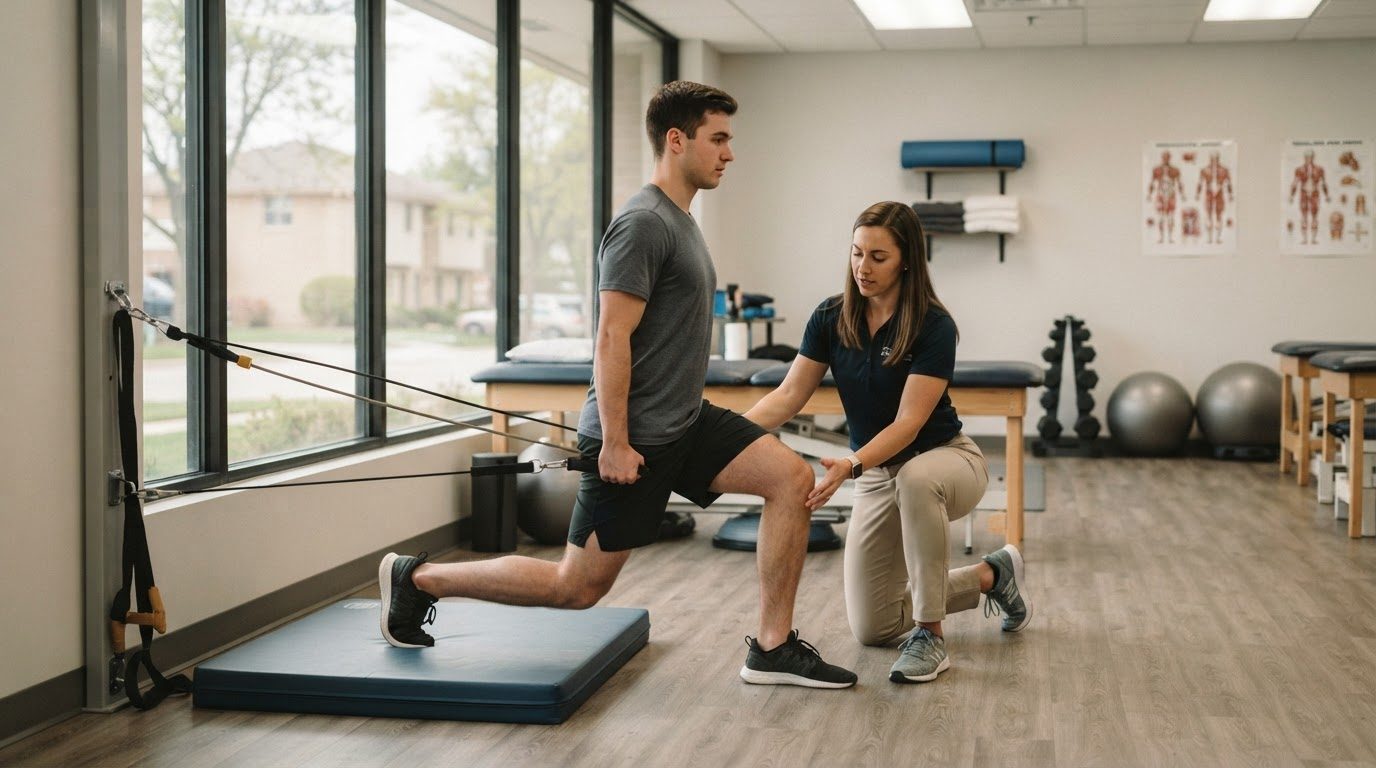
A sports injury does not always begin with a dramatic twist, collision, or fall. Pain can build gradually as training load, repetitive motion, limited mobility, or poor movement mechanics place more stress on a joint or muscle than it can manage. The result may be an injury that affects workouts first, then sleep, work, and ordinary movement.
A Sports injury clinic is intended for active people who need an evaluation and a structured plan rather than guesswork. The right setting depends on the problem: a non-emergency strain or overuse complaint may be appropriate for outpatient care, while severe trauma or symptoms suggesting a medical emergency require immediate attention.
In Lombard, True Health Chiropractic and Acupuncture takes a movement-focused approach, evaluating how the body compensates and creating a personalized plan aimed at restoring strength, mobility, and control. Its sports injury care addresses conditions ranging from runner’s knee and ankle sprains to rotator cuff injuries and plantar fasciitis.
First decide whether this is a clinic problem or an emergency
Not every injury should wait for a standard appointment. Seek emergency care for signs such as:
- A visible deformity or a joint that appears out of place.
- Inability to bear weight after a significant injury.
- Loss of feeling, marked weakness, or a limb that becomes unusually pale, blue, or cold.
- Heavy bleeding, a deep wound, or an exposed bone.
- Severe head, neck, or back trauma, especially with confusion, fainting, repeated vomiting, or worsening neurological symptoms.
For a non-emergency injury, prompt assessment still matters. Continuing to train through swelling, instability, altered movement, or sharp pain can increase stress on other tissues and make it harder to identify the original problem. A sports injury clinic is generally suited to complaints such as persistent soreness, restricted motion, suspected sprains, overuse pain, and injuries that have not improved with rest alone.
If the injury followed a major impact, or if a fracture, tendon rupture, ligament tear, or neurological problem is suspected, a physician or urgent-care evaluation may be necessary. Imaging and specialist referral are sometimes appropriate; hands-on care should not replace that assessment.
Why the painful spot may not tell the whole story
Pain is a warning signal, not always a complete diagnosis. A runner with pain around the knee may also have limited hip control or ankle mobility. Someone with tennis elbow may be dealing with repetitive gripping demands that exceed the forearm’s capacity. An ankle injury can alter walking mechanics long after the initial swelling subsides.
This is why a useful evaluation looks beyond the location of pain. A clinician may consider:
- How the injury started and whether symptoms appeared suddenly or gradually.
- Which movements reproduce the symptoms.
- Strength, range of motion, balance, and joint control.
- Training volume, work demands, footwear, equipment, and recent changes in activity.
- Whether another area is compensating for restricted or painful movement.
True Health’s stated approach centers on movement patterns, muscle imbalance, joint stress, and stabilization. The goal is to understand why a problem is persisting, then build care around the individual rather than applying the same routine to every athlete.
That approach is especially relevant for recurring injuries. If symptoms improve temporarily but return whenever activity resumes, the issue may involve load management, technique, strength, mobility, recovery, or a combination of factors. A personalized assessment helps separate those possibilities.
Conditions commonly evaluated in sports injury care
Sports injury clinics may see both competitive athletes and people whose “sport” is running before work, lifting at a gym, playing golf, or joining a weekend pickleball game. True Health’s sports injury page specifically identifies care plans for:
Lower-body complaints
- Runner’s knee.
- Ankle sprains.
- Shin splints.
- IT band syndrome.
- Plantar fasciitis.
- Hip flexor strains.
- Hamstring pulls.
These conditions can involve acute tissue damage, repetitive loading, or movement changes that develop over time. Treatment should reflect the suspected tissue and severity. For example, an acutely swollen ankle may need protection and a gradual return to weight-bearing, while persistent plantar heel pain often requires attention to calf flexibility, foot strength, training load, and footwear.
Shoulder, arm, and upper-body problems
- Rotator cuff injuries.
- Tennis elbow.
- Shoulder impingement.
- Neck tension.
- Low back pain.
Pain with overhead movement, gripping, throwing, or lifting deserves evaluation if it persists or limits strength. Do not assume that a painful shoulder simply needs to be stretched more; aggressive stretching or continued loading can aggravate certain injuries. A clinician should determine which movements are appropriate.
What happens during the first visit
The first appointment should answer practical questions, not leave you with a vague label. At True Health, the stated process begins by listening to the person’s history and understanding what pain is preventing them from doing. Movement is then tested so the findings can be explained in straightforward terms.
A useful first visit typically clarifies:
- What activities are aggravating the injury.
- Which movements are safe to continue.
- Whether the presentation appears appropriate for conservative care or needs further medical assessment.
- What the initial treatment priorities are.
- How progress will be judged.
The plan may focus on reducing irritation first, then rebuilding mobility, strength, coordination, and tolerance for activity. The sequence matters. Returning immediately to full training because pain briefly decreases can overload tissue that has not regained capacity.
Bring relevant information to the appointment: when symptoms began, what caused them, what makes them better or worse, changes in exercise or work, previous injuries, medications, and any imaging or medical records. Be direct about your goals. “I want to run without pain” provides more useful context than simply saying “my knee hurts.”
Recovery is not the same as complete rest
Rest has a role, particularly after an acute injury, but total inactivity is not always the best long-term strategy. The appropriate amount of activity depends on the injury, symptoms, and stage of recovery. In many cases, a gradual progression keeps the body conditioned while avoiding loads that exceed current capacity.
A clinician may help you distinguish between:
- Acceptable effort or mild muscle fatigue.
- Pain that signals excessive load.
- Symptoms that worsen during activity and remain elevated afterward.
- Instability, weakness, or loss of coordination that requires stopping.
Do not use pain medication to conceal symptoms and then continue at full intensity without guidance. Medication can have risks, interact with other drugs, and mask a problem that still needs evaluation. Likewise, injections, supplements, acupuncture, manipulation, or exercise programs are not automatically appropriate for every diagnosis. Treatment should be selected after an assessment, with contraindications and medical history considered.
True Health describes its care as gentle, safe, evidence-based, and natural, with the aim of restoring mobility and athletic performance without drugs or surgery. Those goals should be understood as a treatment philosophy, not a promise that every condition will resolve without medication, imaging, surgery, or referral. Some injuries genuinely require orthopedic or medical intervention.
Choosing care that fits your activity
The best clinic is not necessarily the one using the most techniques. Look for a process that connects diagnosis, treatment, and return to activity.
Useful questions include:
- Will the evaluation examine movement and function, not just the painful area?
- How will the treatment plan change if symptoms do not improve?
- What activities should be modified while healing?
- How will strength, mobility, and readiness to return to sport be assessed?
- When is imaging or referral to another professional recommended?
Convenience also affects recovery. A plan that ignores work, family responsibilities, or training demands is difficult to follow. True Health serves athletes and active individuals near Lombard, Downers Grove, Oakbrook, Glen Ellyn, Wheaton, and Elmhurst, including runners, lifters, golfers, pickleball players, busy parents, and other weekend warriors.
When to schedule an evaluation
Arrange an appointment when pain keeps returning, changes the way you move, limits ordinary activities, or prevents you from training normally. Persistent swelling, weakness, reduced range of motion, clicking with pain, or a feeling that a joint may give way also warrants professional assessment.
Do not wait for symptoms to become severe simply because the injury was not dramatic. Early evaluation can establish what to modify and which movements to rebuild. The aim is not merely to quiet pain for a day; it is to help you resume the activities that matter while reducing the chance that the same problem repeatedly puts you on the sidelines.
